

Compare the final price, not just the daily rate
The lowest daily rate isn't always the cheapest rental. Delivery, mileage, extra drivers, child seats, cross-border travel or a late return can all change what you actually pay.
Compare offers for exactly the same dates and times. On Naudokis.lt you can see the owner's rate, deposit and handover method before sending a request. The number that matters is the full price for your rental period.
| Term | What to confirm |
|---|---|
| Rental period | Exact collection and return times, plus the late fee |
| Mileage | The allowance and the charge for exceeding it |
| Fuel or electricity | The level required when the car is returned |
| Extras | Delivery, drivers, child seats and cross-border travel |
| Cancellation | The deadline and any charge |
The fuel policy deserves a careful read. Full-to-full normally means you pay only for what you use. A prepaid tank works differently: you buy the whole tank up front and get nothing back for what's left, which makes a short trip poor value.
An illustrative calculation, not current market prices: two days at €35 cost €70. With 150 km included per day and extra distance at €0.20/km, a 500 km trip adds €40. Add €15 delivery and the total is €125. Two days at €42 with unlimited mileage and free collection cost €84. Any other charges still need comparing on both offers.
Before you confirm, save a screenshot of the total and what it includes. It's far easier than trying to reconstruct the offer later.
The deposit, excess and insurance cover different risks
| Term | What it means |
|---|---|
| Deposit | Money held or paid temporarily against possible charges |
| Excess | The amount you remain responsible for in an insured incident |
| Compulsory third-party cover | Covers damage to other people, not repairs to the rental car itself |
| Additional protection | May reduce your liability but usually has exclusions |
Check the exclusions for glass, tyres, wheels, the underside, roof, interior, keys and incorrect fuel. And if someone who isn't named in the agreement causes damage, the cover may not pay out at all.
A €600 deposit and a €1,000 excess aren't the same thing. After a small insured loss, the owner may hold the deposit while your final liability is worked out from the excess, the exclusions and the repair cost. Get each amount in writing.
Ask what evidence supports a damage charge — dated photographs, an estimate, a repair invoice or an independent assessment. A clear process protects both sides, and it makes an honest mistake much easier to challenge.
Commercial vehicles often have different limits. Our van rental guide covers roof and body damage in more detail.
Before collection: documents, drivers and travel plans
You'll need a valid driving licence, identification, the reservation confirmation and the payment method named in the agreement. Anyone who might drive has to be in the agreement too.
- Check the minimum age, driving-experience and additional-driver terms.
- Get written permission for cross-border travel, ferries or a one-way return.
- Agree whom to contact if the car breaks down or is involved in a collision.
- In cold weather, inspect the tyre markings and visible condition.
Winter tyres are compulsory in Lithuania from 10 November to 31 March. If the tyres look unsuitable or damaged, sort it out with the owner before setting off.
For a trip abroad, the owner's permission is only the start. You'll also want the insurance to hold along the whole route, any extra document sorted out, and a straight answer on whether roadside assistance operates beyond Lithuania. Ferries, unpaved roads and some territories carry their own restrictions.
If a document or payment requirement at collection doesn't match the offer, don't accept a hurried substitution. Have the change — and any extra charge — confirmed in the platform messages before you leave.
Take matching photographs at collection and return
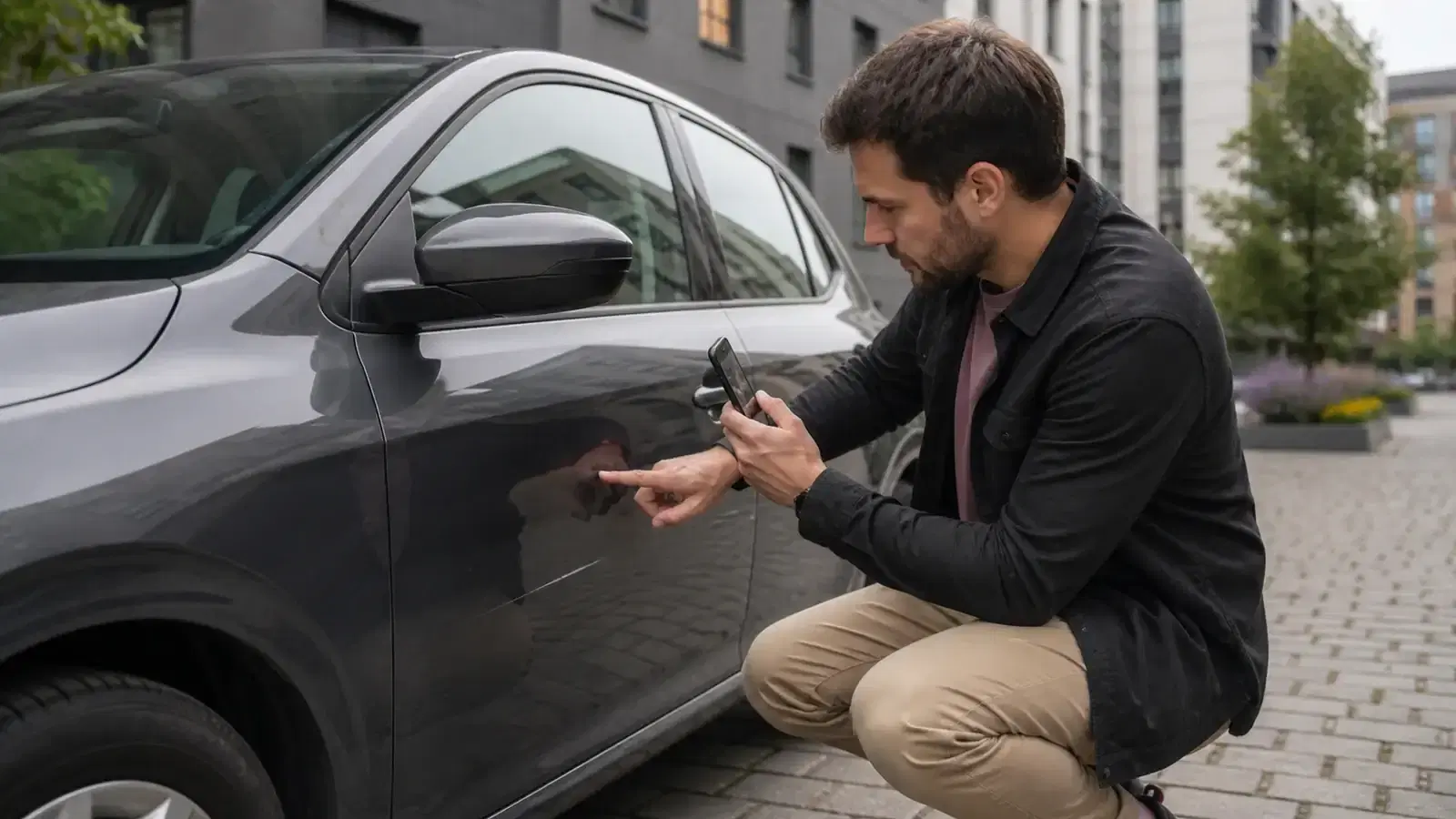
Allow enough time to inspect the car in good light. Walk around it in one direction and photograph each mark close up and in a wider view. If dirt, darkness or wet weather limits the inspection, note that in the handover record before setting off.
The wider shot shows where a mark is; the close-up shows how bad it is. Keep the original dated files and add anything significant to the handover record — a lone close-up is hard to match to a particular door or bumper later.
Checklist
- All four sides, corners, roof and sills
- Windows, lights, wheels and tyres
- Interior, boot, keys and supplied accessories
- Mileage and fuel or battery level
- Existing damage included in the handover record
- The same photographs repeated at return, including the location and time
Don't hand the wheel to anyone who isn't named in the agreement, and don't arrange repairs without permission. If a warning light comes on or the car develops an unfamiliar noise, stop somewhere safe and call the contact in the agreement.
After a collision, people come first — call 112 if needed. Then photograph the scene, collect the other parties' details, complete an accident statement and let the owner know.
Leave time for fuel or charging before the return, and keep the receipts and acceptance record until the deposit is released. If you're dropping the key out of hours, agree in advance when your responsibility ends.
Toll, parking and low-emission-zone notices can reach the owner weeks after the return, so keep payment receipts for a few months. If a charge does arrive, match its date and location to your journey and check any administration fee against the agreement.
Don't use a car wash the agreement prohibits, and never try to hide a new mark — tell the owner before the return inspection.
Plan the charging and return level for an electric car
Plan around realistic range and chargers you know are working, not the laboratory figure. Cold weather, motorway speeds, a roof box and a full car all eat into the range.
- Charging. Agree who pays at public chargers and whether a card or app is supplied.
- Range. Leave a larger margin in winter, on motorways and with a heavier load.
- Equipment. Photograph the cable, adaptors and their condition with the car.
- Return. Charging takes time, so reach the required battery level before the return deadline.
If the car has to come back at 80%, plan the last charge before you reach the handover point. Check whether the charger needs your account or the owner's card, and how the electricity you use will be billed.
Check who the agreement is with and how cancellation works
Check whether the owner is a business or a private individual. Consumer protection rules apply when you rent from a trader; between two private individuals they don't work the same way.
The rental agreement is between the owner and renter. Naudokis can administer payments and make internal claim decisions under its terms and the evidence provided; those decisions do not remove your right to challenge them through the applicable procedure. Keep the offer terms and messages.
The usual 14-day cooling-off right generally doesn't apply to a car reserved for specific dates, so read the cancellation deadline and charges before you confirm.
If your plans are still loose, pick cancellation terms you can live with rather than the lowest rate. Moving a reservation from Friday to Saturday can count as a brand-new reservation — get any change confirmed in writing.
If you dispute damage or a charge from a business, start with a written complaint to the provider. If the answer doesn't satisfy you — or none arrives within 14 days — you can take it to Lithuania's State Consumer Rights Protection Authority, VVTAT.
Related articles
 Vehicle rentalVan rental: choosing the size, payload and return terms8 min read
 Tools and constructionRent or buy tools? A simple calculation and 15 examples10 min read
 Rent or buy30 things that often make more sense to rent than buy11 min read
Sources
This guide draws on EU and Lithuanian driving, insurance and consumer-rights sources. It offers general guidance for comparing terms and recording condition, not a legal opinion on a particular dispute. An agreement cannot override rights granted by mandatory law.
- Hiring and driving a car in another EU countryYour Europe
- Motor insuranceEuropean Commission
- Driving licence and car insurance validity in the EUYour Europe
- Directive 2011/83/EU on consumer rights, Article 16(l)EUR-Lex
- Kelių eismo taisyklės, aktuali suvestinė redakcijae-TAR
- Transporto priemonių valdytojų civilinės atsakomybės privalomojo draudimo įstatymasLietuvos Respublikos transporto priemonių draudikų biuras
- Standartinės transporto priemonių valdytojų civilinės atsakomybės privalomojo draudimo sutarties sąlygosLietuvos Respublikos transporto priemonių draudikų biuras
- Transporto priemonių draudimasLietuvos bankas
- Civilinis kodeksas, šeštoji knyga, aktuali suvestinė redakcijae-TAR
- Kaip pateikti prašymą dėl vartojimo ginčoValstybinė vartotojų teisių apsaugos tarnyba
- Kaip nenukentėti nuomojantis automobilį?Valstybinė vartotojų teisių apsaugos tarnyba