

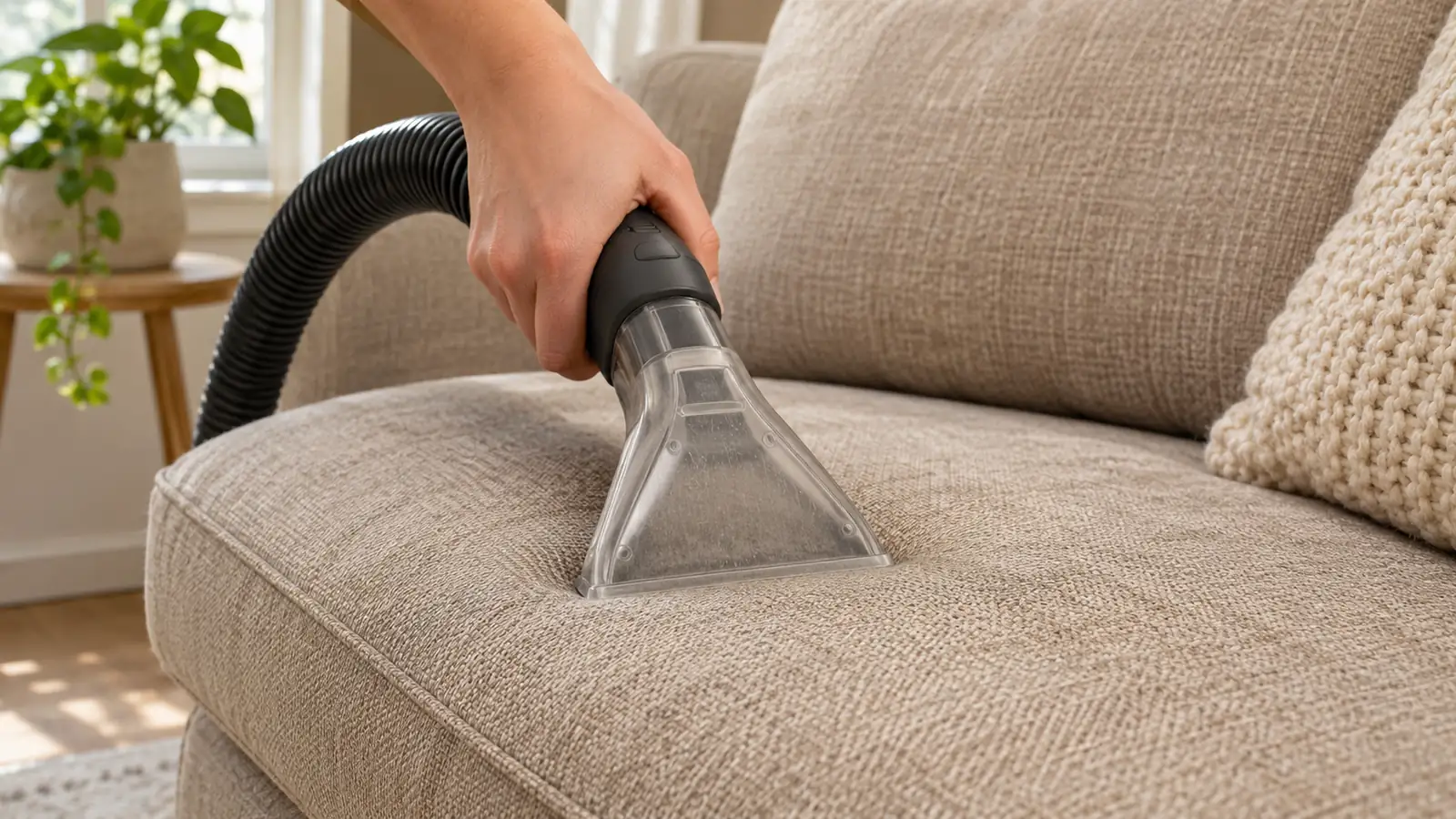
1. Check if your sofa can be extraction-cleaned
Look for the care label under the seat cushions, near a zip or on the underside of the sofa. If it gives little detail, look up the manufacturer's instructions for the exact model. Check any decorative trim and sections covered in a different fabric. A single sofa can have more than one set of care instructions.
| Code | What it permits | Can I use an extractor? |
|---|---|---|
| W | Water-based upholstery shampoo or foam. Do not overwet. | Only if the manufacturer permits extraction. |
| WS / W-S / SW | Mild water-based detergent, foam or dry-cleaning solvent. Do not overwet. | Only if the manufacturer permits extraction. |
| S | Dry-cleaning solvent only. No water. | No. |
| X | No water or solvent cleaners. Vacuuming or light brushing only. | No. |
| No code | Follow the instructions for the exact piece of furniture. | If you cannot find them, check with the manufacturer or a specialist. |
A W code alone does not mean you can wash the whole sofa. La-Z-Boy, for example, says W fabrics should be spot cleaned only and does not recommend hot water extraction or steam cleaning. For leather and suede, follow the material-specific care instructions. With velvet, silk, viscose or wool upholstery, find out which method the furniture manufacturer permits before choosing equipment.
How does an extractor differ from a steam cleaner?
An ordinary vacuum collects loose crumbs, dust and hair. A spray extractor applies cleaning solution and draws it back into a separate tank with the loosened dirt. A steam cleaner uses hot vapour. Check the care instructions for each method individually.
2. Vacuum the sofa and gather your supplies
Use a dry vacuum with an upholstery attachment on the seats, back and arms. Switch to a crevice tool for seams and gaps. Move nearby rugs and protect exposed wood from splashes. Set aside a place to dry removable cushions and make sure you can keep air moving in the room after cleaning.
Checklist
- An upholstery nozzle, hose and two clean tanks.
- A detergent suitable for both the upholstery and the extractor.
- A white absorbent cloth to blot spills and check for colour transfer.
- Time for a test patch to dry and airflow for the sofa after cleaning.
Which extractor should you rent for a sofa?
Check the attachments first. A narrow upholstery nozzle is easier to keep flat on an armrest or run along a seam. Ask the owner what detergent comes with the machine, how to dose it and how to vacuum without spraying.
- Kärcher Puzzi 10/1 listing in Vilnius lists a small nozzle for upholstery and two RM 760 tablets. The manufacturer's manual doses these at 2 tablets per 8 litres of water. Check that the product suits your upholstery.
- Santoemma Sabrina kit listing in Vilnius includes a dry vacuum, the extractor, a main cleaning product, a stain product and cleaning instructions. Ask which nozzle is meant for furniture and which fabrics the included products suit.
If you plan to clean a rug during the same rental, check that the kit includes a floor nozzle. Our carpet cleaning guide compares rental and professional cleaning costs by area.
3. Choose a detergent and test a hidden patch
Use the detergent named in the extractor's manual, provided it also suits your upholstery. Follow the product label for dilution. Keep household cleaners and homemade mixtures out of the tank. Warm water cleans better, but the Puzzi 10/1 solution must not exceed 50 °C, and you should check that the fabric tolerates the heat. Inspect the cord and hoses before setting up. Fit the upholstery nozzle, fill the clean-water tank with solution and seat the empty recovery tank.
Try the product and the planned cleaning method on a hidden patch of the same fabric. Use a white cloth to check for colour transfer. Let the patch dry fully and look at it in daylight. Stop if you see a ring, a change in shade or a change in texture.
What should you do about a stain before extraction?
For a fresh coffee spill or other liquid, gently blot with a white cloth from the edge towards the centre. Avoid rubbing. If a spot treatment is needed, use a product the manufacturer permits. Follow the stated contact time and remove any residue as directed. If you do not know what caused the mark, do not soak it; ask an upholstery cleaner instead.
4. Clean in sections and extract the moisture
Start with one section, such as the top of a seat cushion. Pull the nozzle towards you (do not push it) in slightly overlapping passes. Spray only enough to dampen the fabric evenly and extract the solution straight away. For more delicate fabrics, the Puzzi manual advises less detergent, spraying from about 20 cm and finishing with suction only. If extraction is allowed and you are cleaning for a single mark, clean the whole panel up to its seams to avoid leaving a ring.
Finish each section with suction-only passes. Release the spray trigger, keep the suction on and go over the same area until the nozzle picks up very little liquid. Repeated suction-only passes shorten the drying time. Avoid repeated wet passes at seams and corners. Stop if the material becomes too wet or starts transferring colour. If rinsing is required, follow the detergent, furniture and extractor instructions.
5. Dry the sofa and clean the extractor
Ventilate the room and use a fan if airflow is limited. Prop removable cushions apart so air can reach both sides. Wait until the upholstery is dry throughout before sitting on it, putting the cushions back or covering the sofa. Check the seams and undersides of cushions, which can stay damp after the top feels dry.
How long does a sofa take to dry after extraction?
BISSELL advises allowing at least 4 to 6 hours for upholstery to air dry after a deep clean. Thick upholstery, a humid room or a wetter fabric will take longer. If you want to use the sofa that evening, clean it in the morning. Decide by feeling the seams and cushion undersides, not by the clock.
Empty the recovery tank. Rinse the tanks, nozzle and hose as directed in the machine's manual, let the parts dry and pack them for return as agreed with the owner.
When should you call an upholstery cleaner?
Ask a specialist if you cannot find the care instructions, the fabric is delicate or colour transfers during testing. It is also worth getting advice if a smell returns after drying, liquid has soaked into the filling or an old stain is spreading. Tell the cleaner what caused the stain and which products you have already tried. For routine upkeep, vacuum the upholstery regularly and blot fresh spills promptly.
Can removable sofa covers go in the washing machine?
Only if the manufacturer allows it and gives washing and drying directions. A zip alone is not permission: Pallas Textiles says cushion covers on its W, S and WS fabrics should not be removed and laundered. Permission to wash a cover applies to that cover only, not to the filling or the rest of the sofa.
Related articles
 Home and cleaningCarpet cleaning at home: rent a cleaner or hire a professional?
 Home and cleaningWindow-cleaning robot rental: when it works and what to check
 Rent or buy30 things that often make more sense to rent than buy
Sources
We used furniture and textile manufacturers’ care guidance, checked the equipment and attachments against manufacturers’ documents, and reviewed the rental listings for the advertised kit contents. The photo is illustrative.