

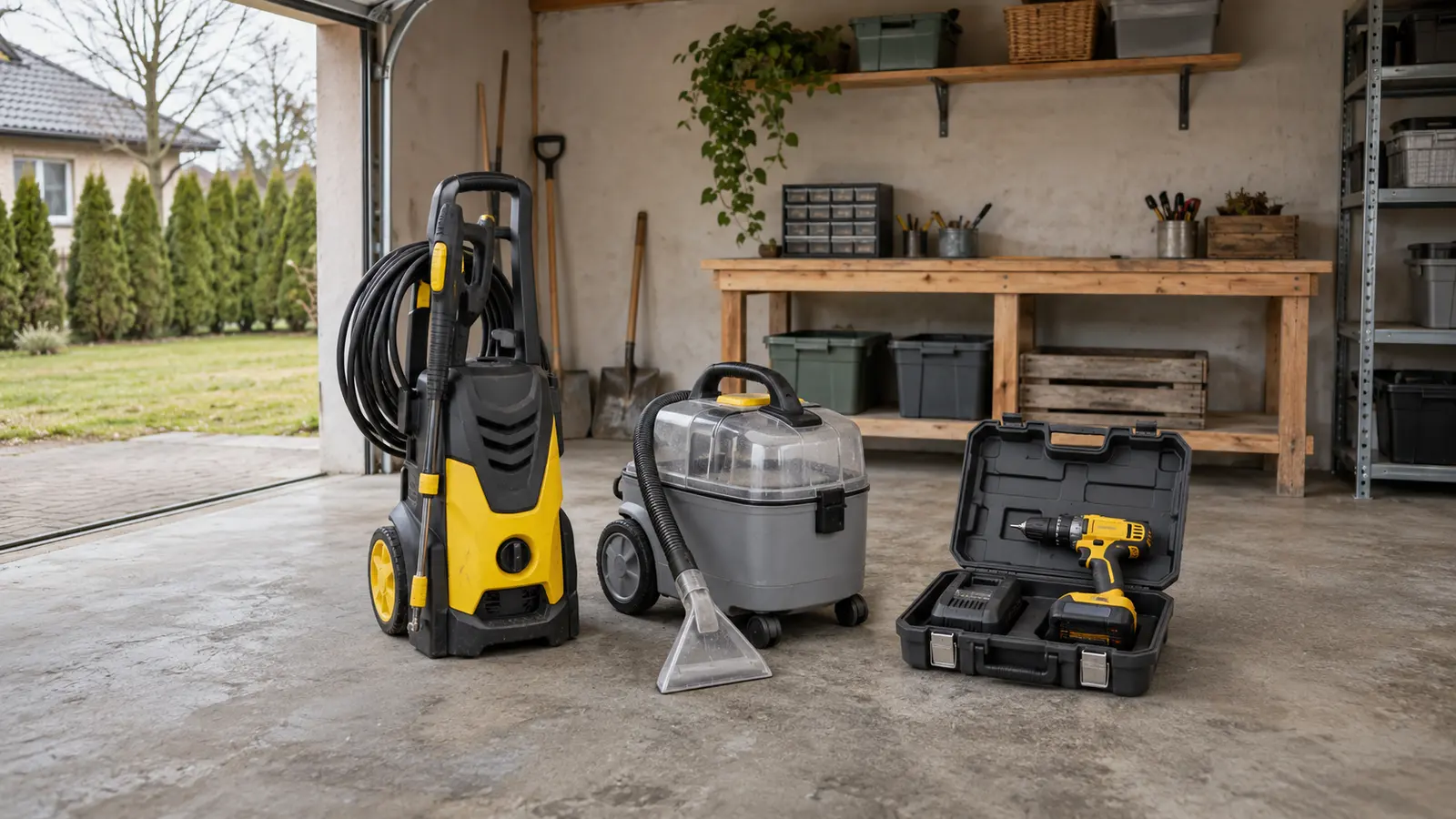
What daily rates are owners advertising?
Five active Naudokis listings checked on 11 November 2026 advertised daily rates of €10–€37. These rates tell you what owners are asking. They give no information about what people have actually paid or how frequently each item goes out.
| Equipment and location | Advertised daily rate | After commission |
|---|---|---|
| Kärcher K3 pressure washer, Vilnius | €10 | €7.50 |
| Husqvarna G 3200P generator, Vilnius | €15 | €12.50 |
| Kärcher Puzzi 10/1 carpet extractor, Vilnius | €16 | €13.50 |
| Concrete mixer, Garliava | €20 | €17.50 |
| Festool drywall sander and extractor, Vilnius | €37 | €33.30 |
The last column applies standard commission to a single day with no delivery or discount. Your own costs and any taxes still come out of that amount. The Festool listing mentions a separate charge for a required dust bag, which the figures exclude.
Compare offers near you for similar models and accessories. Look at the nozzles and detergent included with carpet extractors. For pressure washers and generators, power and fittings set the price, so state them clearly in your listing. For a mixer, check capacity and what it takes to transport. Compare a sander with an extractor against other complete power-tool kits.
How much could one tool earn in a month?
Start with a carpet extractor at €16 per paid day and assume no delivery or discounts. Allow €3 per reservation for detergent and preparation, €2 per rental day for depreciation and €8 per month in fixed costs. The costs below are assumptions. Account for your time, taxes and unexpected breakdowns separately.
| Days and reservations | Rental revenue | After commission | Profit before tax |
|---|---|---|---|
| 0 days | €0 | €0 | −€8 |
| 2 days (1 + 1) | €32 | €27 | €9 |
| 5 days (2 + 2 + 1) | €80 | €71.10 | €44.10 |
| 10 days (5 × 2) | €160 | €144 | €101 |
In the five-day example, the two two-day rentals cost €32 each and carry €3.20 commission each. The single day carries the €2.50 minimum. That takes €8.90 off €80 and leaves €71.10. After €9 for preparation, €10 for depreciation and €8 in fixed costs, operating profit is €44.10 before tax.
Calculate utilisation against days when you could genuinely let the item go. Five paid days out of 20 available days would be 25% utilisation. The scenarios let you test your costs before you have a record of your own reservations.
How do you calculate tool rental profit?
Apply the commission to each reservation individually. On a €10 one-day rental the €2.50 minimum takes a quarter of the rental price. At a chargeable reservation value of €25, 10% and the minimum are equal.
Which costs should you include?
- Per rental. Allow for detergent, discs, dust bags, cleaning and any transport. Count the time spent answering messages, testing the equipment and meeting the renter for collection and return. Compare what you keep with what that time is worth to you.
- Per month. Include extra storage, insurance and regular servicing where you pay for them. Spread periodic bills over the months the calculation covers.
- Over the life of the tool. Plan for worn parts and repairs. To estimate the share of depreciation attributable to rentals, use the tool's current value, expected resale value and remaining usable days. Count each cost once.
Plan upkeep around the manufacturer's instructions. A Puzzi 10/1 needs draining and rinsing after use, while a petrol generator needs engine oil and air filter maintenance. Price the parts and servicing for your model, and record how long preparation actually takes.
When is a longer-rental discount worthwhile?
Suppose you rent the extractor to four different renters, each for one day at €16. After €10 commission, €12 preparation and €8 depreciation, you keep €34. One four-day reservation at a 15% discount brings in €54.40. Take off €5.44 commission, €3 preparation and €8 depreciation and you keep €37.96. Both figures are before fixed costs and tax.
If the same renter paid full price for all four days, you would keep €46.60. A discount works best when it fills days that would otherwise sit idle or reduces handovers. Check whether it ties up the tool over a weekend you could have rented at full price.
Is it worth buying equipment to rent out?
Starting with a tool you own avoids a new purchase. Weigh the extra work and wear, the money you could get by selling the tool and the days you need it yourself. Buying expressly for rental ties up money straight away, and the tool can lose value even while it sits idle.
Suppose equipment and accessories cost €400. For six months, the five-day scenario leaves €54.10 a month in cash after commission and expenses (€44.10 operating profit plus €10 depreciation). For the other six months, there are no rentals and you still spend €8 a month. Allow another €36 for a repair that year. The annual cash surplus would be €240.60 before tax. If that result repeats, the average monthly surplus gives a simple payback of about 20 months before tax.
How can you test demand locally?
Compare the full price, condition and collection distance on similar local listings. Once your own listing is live, record the dates people ask for, which requests turn into rentals and why you turn the others down. Spring garden work can matter for one tool, while indoor renovations or upholstery cleaning can matter for another. Include months without rentals and time out for repairs in any purchase calculation until you have your own evidence. If you rent out equipment through a company, see how a rental business can get more orders.
When do you get paid, and how do you handle damage?
When the renter submits a request, the payment amount is authorised on their card. The system charges for the rental once you accept. Any deposit is handled separately, so do not count it as rental income. Check the payment status before handing over the tool. A payout starts after completion and settlement if your payout account is ready and there is no dispute or other restriction. See how Naudokis works for owners.
Hand over a working tool fit for the agreed purpose. Test it together, explain safe use and photograph its condition and accessories. Repeat the check on return. Report damage or a missing accessory through the reservation before its deadline. A deposit may cover part of the damage under the terms of use. Consider insurance and what downtime would cost you.
How do you declare tool rental income in Lithuania?
Lithuania’s tax authority, VMI, says one-off, occasional or passive letting of movable property does not require individual activity registration. If you rent to another individual outside individual activity, you generally declare the income and pay income tax yourself by 1 May of the following year. When renting to a company, VMI says the company withholds income tax. For income received in 2026, a 15% rate applies to the part that, together with other annual income counted towards the same threshold, does not exceed 12 average monthly wages (€27,745.80). Progressive rates may apply above it. Check VMI’s guidance on rental income from other property.
Independent, ongoing rentals carried out for economic gain require individual activity registration. VMI looks at the circumstances as a whole. Individual activity has its own income tax and record-keeping rules, and social and health insurance contributions and VAT registration may apply. Keep records of each rental amount, fee and payout, plus documents supporting your expenses. Ask VMI if you are unsure how to classify your income or expenses.
Where should you start if you already own the tool?
Checklist
- Test one tool, gather its accessories and photograph its actual condition.
- Set a rate that makes even a one-day rental worth your time and block the dates in its calendar when you cannot hand it over.
- Add the model, what comes with it and the collection location. Complete any account checks, select Publish and check that the listing is active.
If the listing form does not open after installation, sign in and tap Add in the bottom menu. Private owners need to verify their phone number and identity, and provide a public display name if prompted. For the full process, see how to rent out your things in Lithuania.
Related articles
 For rental ownersHow to rent out your things in Lithuania: from listing to first rental
 For rental businessesEquipment rental: how can your business get more orders?
 Tools and constructionRent or buy tools? A simple calculation and 15 examples
Sources
We checked five public Naudokis listings and the standard platform fees on 11 November 2026. Rental days and costs were chosen to demonstrate the calculations. Tax information comes from VMI and Sodra. The cover photograph is illustrative.
- Standard platform fees (JSON)
- Naudokis terms of use
- How is rental income from other property taxed?
- Do you need to register individual activity when renting out property?
- Record-keeping and other duties for individual activity
- VAT registration guidance
- Social insurance for individual activity
- Civil Code, Article 6.483
- Puzzi 10/1 operating and maintenance instructions
- G 3200P operating and maintenance instructions