

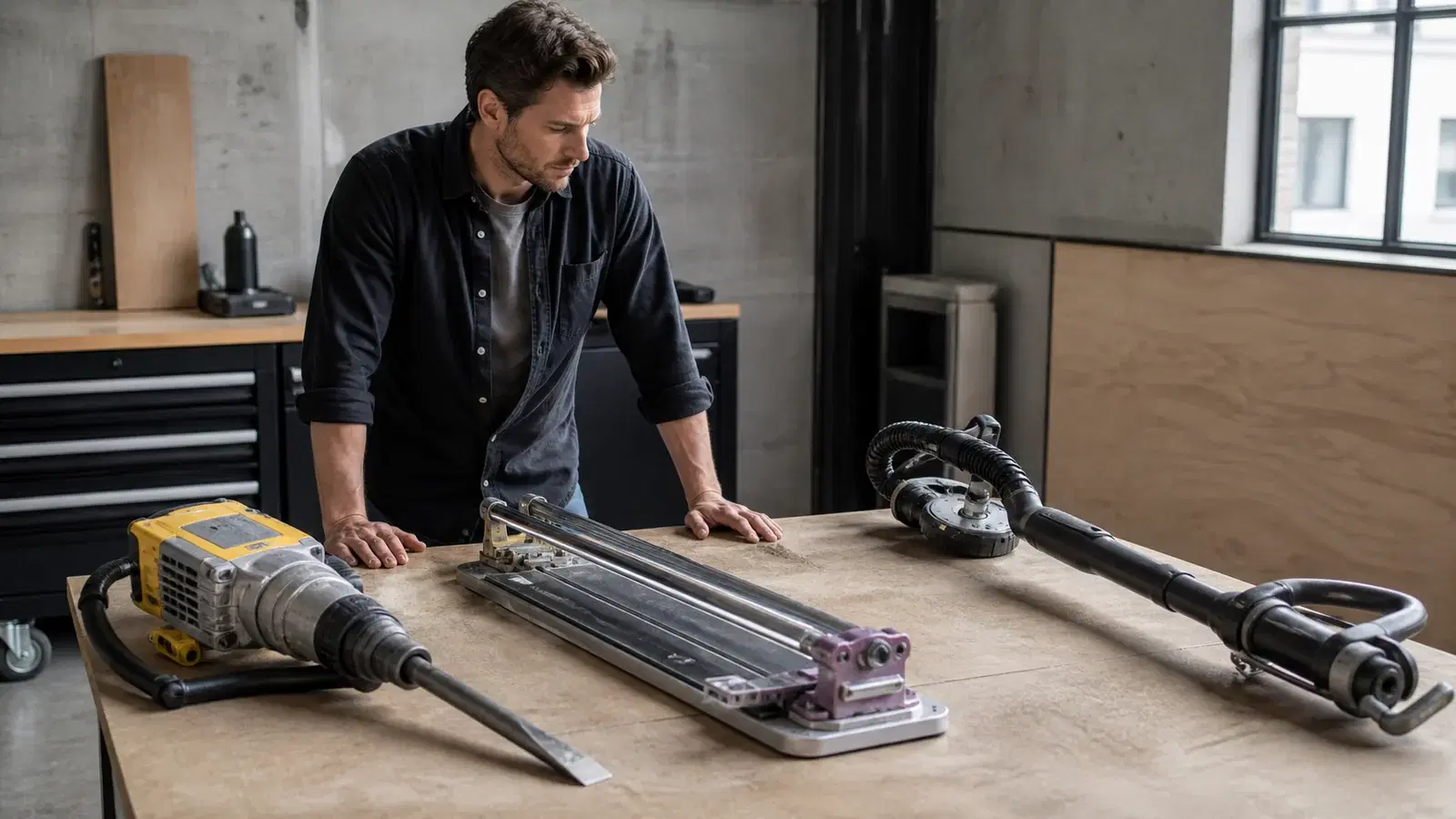
Compare the full cost of the project
The rental rate is only part of the cost — add blades, bits, abrasives, cleaning, delivery and any days the tool will sit unused. A purchase has its own hidden lines: maintenance, repairs and storage.
Be realistic about time. A floor-sanding job planned for one day can swallow the weekend once furniture is moved, protruding nails are dealt with and several grades of abrasive have been worked through. Reserving enough time up front is cheaper than a late return or a rushed, damaged surface.
Judge a purchase across everything you'll do with it, not just this project. If the tool then sits in a cupboard for three years, battery ageing, resale value and the space it takes up are part of the price of owning it.
Check how the rental period is counted, too. Collect on Friday evening and return on Monday morning, and you may be charged for three days even though the work happened on Saturday. If weather or drying time could interrupt the job, ask what an extension costs — and whether someone else has the tool reserved straight after you.
A Naudokis deposit is normally held on the card rather than charged as rental income. It reduces the available card limit, so check the amount and the conditions for releasing the hold separately from the project price.
Choose for the job, surface and accessories
| Question | Why it matters |
|---|---|
| What is the material? | Concrete, timber, metal and tile need different accessories |
| What area or depth? | This determines the power, capacity and working time |
| What power is available? | Heavy equipment may need a dedicated circuit or three-phase supply |
| What is included? | Blades, bits, hoses and dust extraction can change the final price |
| How will it travel? | The size and weight may require a van or two people |
Send the owner a photograph of the work area, the material and the dimensions. ‘I need to sand 35 m² of varnished oak flooring’ is far more useful than ‘have you got a sander?’
The supplied equipment can decide whether the job starts at all. A wall chaser without suitable extraction, a cutter with the wrong blade or a pressure washer with a short hose can turn the rental day into an urgent shopping trip.
Don't default to the most powerful model. Extra weight and torque only help if you can control the tool, carry it, and use it in the position the manufacturer intends.
Think about loading and unloading as well. A plate compactor, floor sander or mixer may not fit in a car — or be safe for one person to lift. Check the transport position too, especially for fuel-powered or water-fed equipment: some machines cannot simply travel lying down.
Breaking, drilling and cutting
These tools spare you a great deal of manual effort, but one mistake can reach a hidden cable, a pipe or a structural element. Before anything comes down, know what's behind the surface, how you'll control the dust and where the waste is going.
Demolition hammer
- Rent when
- For one stage of breaking concrete, a step or a partition.
- Buy when
- If demolition is regular work and you have suitable transport and storage.
- What to check
- The chisel, weight, vibration control and cable, plus eye, hearing and respiratory protection suited to the material.
Diamond drilling rig
- Rent when
- For a small number of accurately sized holes in masonry or concrete.
- Buy when
- If you install building services regularly and can set the rig up safely.
- What to check
- Core size, cooling, anchoring, residual-current protection and the location of hidden services.
Wall chaser and extractor
- Rent when
- For one electrical or pipework project.
- Buy when
- If you cut channels frequently and own suitable dust extraction.
- What to check
- Cut width and depth, blade condition, extractor compatibility and protection suited to the dust produced by the material.
Professional tile cutter
- Rent when
- For one bathroom, kitchen or large-format tile project.
- Buy when
- If you lay tiles regularly and often work with the same sizes.
- What to check
- Maximum straight and diagonal cuts, blade or wheel condition, water system and transport case.
Plasterboard lift
- Rent when
- For one ceiling project or a small team fitting boards overhead.
- Buy when
- If the lift will move between sites regularly.
- What to check
- Lifting height, capacity, wheel brakes, stability and whether the folded lift fits through the building.
Finishing and diagnostics
Finishing work lives or dies by preparation and consumables, so count abrasives, filters and cleaning time before you reserve. A thermal or drain camera shows you evidence, not the cause — complex findings may still need an experienced surveyor or tradesperson.
Floor sander
- Rent when
- For restoring the floor in one room or one property.
- Buy when
- If floor restoration is part of your regular trade.
- What to check
- Abrasives, an edge sander, dust bags and any protruding nails or screws in the floor.
Drywall sander
- Rent when
- After a one-off large plastering or filling job.
- Buy when
- If you do finishing work regularly and already have compatible extraction.
- What to check
- The extractor connection, disc size, extension length, spare abrasives and the combined weight in use.
Concrete mixer
- Rent when
- For a fence, steps or a small path.
- Buy when
- If you mix material often and have somewhere to clean and store the machine.
- What to check
- Usable drum capacity, power supply, stability, transport dimensions and the cleaning agreement.
Drain cleaner with camera
- Rent when
- To diagnose and clear one specific blockage.
- Buy when
- If you maintain several properties and are trained to control the cable safely.
- What to check
- Pipe diameter, cable length, camera recording, the right heads and hygienic cleaning after use.
Thermal camera
- Rent when
- For a one-off search for heat loss or moisture patterns.
- Buy when
- If you survey regularly and understand emissivity and environmental effects.
- What to check
- Resolution, temperature range, calibration, battery condition and whether radiometric files can be saved.
Outdoor and ground work
Outdoor machinery needs access, somewhere safe to unload and ground that can take it. Send the owner photographs of the gates, slopes and working area, and agree the fuel level, who pays for damaged cutters and how clean it should come back.
Plate compactor
- Rent when
- For the base of one path, patio or small paved area.
- Buy when
- If you prepare bases regularly and have safe transport.
- What to check
- Operating weight, suitability for the material, fuel, transport wheels and whether a rubber mat is needed.
Earth auger
- Rent when
- For fence or deck post holes completed in one stage.
- Buy when
- If you drill similar holes regularly in familiar ground.
- What to check
- Auger diameter, required operators, stony ground and underground services before the equipment arrives.
Stump grinder
- Rent when
- For one or a few accessible stumps.
- Buy when
- If grounds maintenance is your regular work.
- What to check
- Access width, cutter condition, guards, a safe exclusion zone and hidden stones or metal.
Wood chipper
- Rent when
- After seasonal pruning has produced one large pile.
- Buy when
- If a large garden creates several batches each season.
- What to check
- Maximum branch diameter, feed system, emergency stop, fuel or power needs and the discharge direction.
Professional paint sprayer
- Rent when
- For one large wall, façade or fence project.
- Buy when
- If you spray regularly and can clean the system properly after every use.
- What to check
- Paint and nozzle compatibility, filters, hose length and protective equipment specified by the product safety data.
The right tool is only one part of working safely
Read the manual for the exact model and practise the controls somewhere safe. Check the guards, brakes, cables, hoses and emergency stops. A quick demonstration from the owner doesn't replace whatever training the work itself requires.
Cutting concrete, brick and some stone products can release hazardous fine dust. Use the wet method or extraction specified for the equipment and respiratory protection selected for the material and risk. Unknown older material that may contain asbestos should be assessed by a competent specialist before it is disturbed.
Protective equipment must fit the person as well as the task. Loose gloves, a poorly sealed respirator or damaged eye protection create false confidence. Tie back long hair, remove loose jewellery and work from a stable position.
Keep children, animals and bystanders outside the work area. Plan where cables, hoses and offcuts will lie, and agree clear signals when two people are lifting or freeing a jam. If you're tired or rushing, stop — working around a guard isn't a shortcut worth taking.
Plan noisy work for permitted hours, protect people nearby and decide where the waste will go. Dust is easiest to control where it's generated, not swept up afterwards.
Before taking the tool away and returning it
Test the equipment while the owner is still there — and go beyond checking that the motor starts. Try the speed controls, guards, water feed and dust extraction, and every supplied battery and charger.
Checklist
- Record the exact model, serial number and supplied equipment
- Switch the tool on and test it briefly in a safe setting
- Photograph damage, meters, blades and other wear parts
- Agree who pays for consumables and normal wear
- Confirm cleaning, fuel or charge level and the return time
- Know whom to contact after a fault and what must not be repaired without permission
Normal wear on an abrasive or blade isn't the same as a broken part or use on the wrong material. Agree the starting condition of wear items and how consumption is charged; a clear photograph at return spares everyone the guessing.
If a fault stops the work, note what happened just before it, what material you were on and any warning the tool showed. A short video can help the owner tell a blocked filter from a real fault. Report it straight away — not at return.
Before paying, check how a missing accessory is valued, whether downtime can be charged and who may operate the tool. Renting the equipment doesn't mean it can be passed to anyone on site.
Start with the tools and construction category and describe the job clearly when you contact the owner.
Related articles
 Rent or buy30 things that often make more sense to rent than buy11 min read
 Home and cleaningWindow-cleaning robot rental: when it works and what to check6 min read
 Vehicle rentalCar rental: what to check before you reserve8 min read
Sources
The examples were selected for short-term use, high purchase cost, transport or storage effort and a condition that can be checked at handover. Safety guidance draws on official VDI and EU-OSHA material; the manual for the exact model remains the primary operating document.