
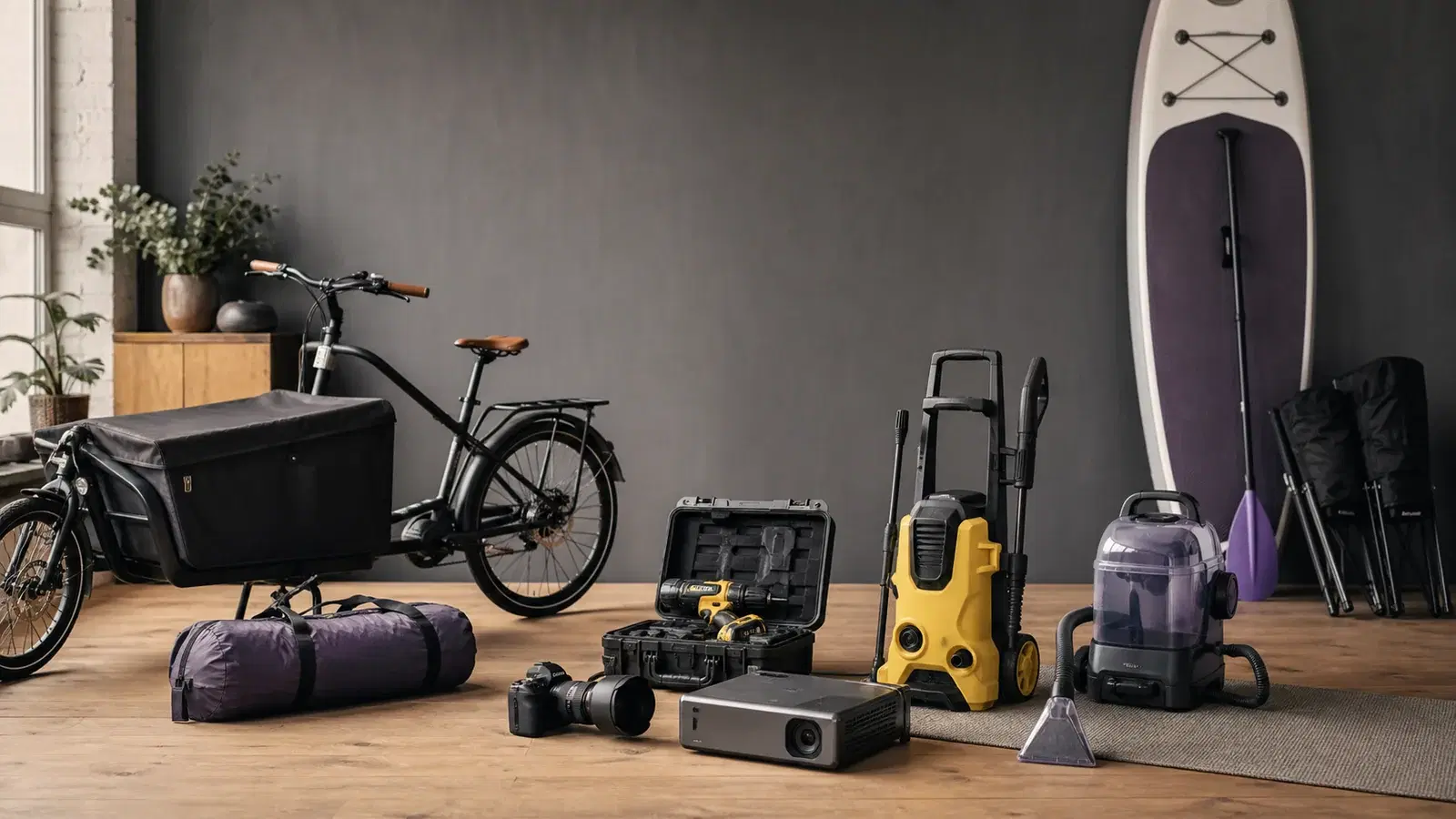
An item is a strong rental candidate when you need it briefly, purchase would tie up substantial money, storage or maintenance is awkward, and condition can be verified at handover. Buy items you use frequently, personalise heavily, place directly against hygiene-sensitive areas or rely on for safety where history matters. Here are 30 categories with a practical boundary for each.
Five signs that rental makes sense
Rental is not automatically cheaper. Add delivery, collection, consumables, cleaning, realistic duration and your time. For purchase, add maintenance, storage, depreciation and disposal, then subtract only a realistic resale value.
Shared use can increase utilisation and support longer product life, but long separate journeys and misuse reduce the benefit. Prefer nearby listings and rent only what the task genuinely needs.
- You need the item for hours, days or one season.
- Purchase price is high relative to the all-in rental.
- Storage, maintenance or transport would add meaningful cost.
- You can inspect condition, completeness and fit before use.
- The owner, agreement, deposit and damage process are clear.
Sources: Council of the European Union, European Commission Joint Research Centre
30 items: when to rent, buy and what to check
Carpet and upholstery extractor
- Rent when
- For deep cleaning a few times a year or before moving out.
- Buy when
- Pets, children or frequent cleaning make it routine.
- What to check
- Clean tanks, hose, heads, approved chemistry and drying time.
Steam cleaner
- Rent when
- For an intensive tile, grout or kitchen clean.
- Buy when
- You use it regularly on approved surfaces.
- What to check
- Heat-safe surfaces, attachments, scale and burn precautions.
Window-cleaning robot
- Rent when
- For seasonal cleaning of large compatible panes.
- Buy when
- Many compatible windows are cleaned often.
- What to check
- Model compatibility, tether, battery, sensors and pads.
Wet and dry industrial vacuum
- Rent when
- After renovation, sanding or a water incident.
- Buy when
- Your workshop produces such waste continually.
- What to check
- Filter class, dust suitability and clean tank.
Dehumidifier
- Rent when
- After a leak, plastering or a short moisture event.
- Buy when
- A diagnosed moisture issue is persistent.
- What to check
- Performance at room temperature, drainage, energy and root cause.
Pressure washer
- Rent when
- For seasonal paving, deck or façade cleaning.
- Buy when
- You have many suitable surfaces and use it often.
- What to check
- Pressure, water flow, nozzle and surface-damage risk.
Demolition hammer
- Rent when
- For one defined demolition stage.
- Buy when
- Demolition is regular professional work.
- What to check
- Weight, bit, vibration, guards and dust control.
Tile cutter
- Rent when
- For one bathroom or kitchen, especially large tile.
- Buy when
- You tile regularly.
- What to check
- Cut length, wheel or blade, water system and transport.
Floor sander
- Rent when
- For one parquet restoration.
- Buy when
- Floor restoration is ongoing work.
- What to check
- Abrasives, extraction, edge machine and floor fixings.
Plate compactor
- Rent when
- For one path, patio or small base.
- Buy when
- You install paving routinely.
- What to check
- Mass, depth, fuel and transport.
Earth auger
- Rent when
- For one fence or deck project.
- Buy when
- You drill similar ground frequently.
- What to check
- Diameter, soil, utilities and operator needs.
Wood chipper
- Rent when
- After one large pruning session.
- Buy when
- A large garden produces repeated batches.
- What to check
- Branch diameter, emergency stop, noise and exclusion zone.
Cargo van
- Rent when
- For moving or one bulky delivery.
- Buy when
- Transport is central to daily business.
- What to check
- Dimensions, payload, licence, height and restraints.
Car trailer
- Rent when
- For garden waste, furniture or materials on a few trips.
- Buy when
- Need is frequent and storage is available.
- What to check
- Combined mass, licence, towbar, lights and restraint.
Roof box
- Rent when
- For one family trip or ski holiday.
- Buy when
- You travel several times a year with the same car.
- What to check
- Bars, compatibility, load, locks and total height.
Car bicycle rack
- Rent when
- For one trip with several bikes.
- Buy when
- You carry bikes frequently.
- What to check
- Mount type, bike weight, lights and plate visibility.
Projector
- Rent when
- For a presentation, film night or one event.
- Buy when
- A fixed room uses it weekly.
- What to check
- Real room brightness, resolution, connections, screen and lamp.
Projection screen
- Rent when
- When the venue wall is unsuitable.
- Buy when
- Presentations recur in the same space.
- What to check
- Size, viewing distance, stand, creases and packed length.
PA speaker system
- Rent when
- For a party, ceremony or small performance.
- Buy when
- You run events and can configure it safely.
- What to check
- Room, output, stands, cables, microphone and noise limits.
Wireless microphones
- Rent when
- For one conference or ceremony.
- Buy when
- Use is frequent in the same technical environment.
- What to check
- Frequency compatibility, receiver, batteries and wired backup.
Event lighting
- Rent when
- For one stage, photo wall or dance floor.
- Buy when
- You have skill, storage and regular events.
- What to check
- Power, stands, safety bonds, control and heat.
Folding chairs and tables
- Rent when
- For guest numbers beyond everyday needs.
- Buy when
- Similar events recur and dry storage exists.
- What to check
- Count, stability, cleanliness, transport and damage record.
Event marquee
- Rent when
- For one outdoor event with a weather plan.
- Buy when
- You operate events with a trained installation crew.
- What to check
- Wind limits, ballast, surface, drainage and installation responsibility.
Camera and lens
- Rent when
- For a trip, event or defined creative project.
- Buy when
- You shoot often and know the system you need.
- What to check
- Sensor, glass, shutter condition, batteries, cards and cover.
Action camera
- Rent when
- For one active trip or sports event.
- Buy when
- You create this material regularly.
- What to check
- Housing seal, mounts, batteries, card and data deletion.
Drone
- Rent when
- For a defined job when you are competent and legally able to fly.
- Buy when
- You fly regularly and maintain registration and batteries.
- What to check
- Operator and zone rules, insurance, props, batteries and weather.
Paddleboard
- Rent when
- For a few summer days on suitable water.
- Buy when
- You paddle often and can dry and store it.
- What to check
- Weight limit, pressure, pump, fin, leash and suitable buoyancy aid.
Kayak
- Rent when
- For one outing or to test a different type.
- Buy when
- You paddle regularly and can transport and store it.
- What to check
- Route, people and luggage limits, paddles, buoyancy aids and pickup.
Skis or snowboard
- Rent when
- For one holiday, a growing child or a trial.
- Buy when
- You ride often, size is stable and maintenance is realistic.
- What to check
- Size, professional binding setup, boots and helmet.
Camping kit
- Rent when
- For a first or occasional trip needing shelter and sleep gear.
- Buy when
- You camp often and know the required weight and comfort.
- What to check
- Complete dry tent, stove compatibility and sleeping-item hygiene.
When rental may be the wrong choice
Treat equipment whose safety depends on invisible history with caution. A child car seat, helmet, climbing rope or fall-arrest device may look sound after an impact. Rent only from a professionally managed source with traceable inspection, or use equipment whose history you know.
Personal-fit and hygiene-sensitive medical, sleeping, oral-care or skin-contact items require a credible professional sanitation process. A cheap object used every week can also be simpler and cheaper to own than repeatedly exchange.
Universal handover checklist
Checklist
- Model, size and intended use match
- Condition and existing marks are photographed
- The complete kit is counted and tested
- Consumables and cleaning rules are clear
- Deposit, liability, lateness and cancellation are understood
- A manual and fault contact are available
- Return place, time and condition confirmation are agreed in writing
How to turn 30 ideas into one sound rental decision
Begin with a use calendar. Estimate the days you will genuinely need the item over the next two years, including collection, return, storage and maintenance. Then consider the cost of being wrong: an unsuitable projector may disrupt an evening, while unknown-history protective equipment can create a much more serious risk. The greater the consequence, the more important professional inspection and a traceable history become.
After choosing a category, compare at least two live offers over the same period and with the same kit. One may include delivery, cables or cleaning; another may advertise a lower base rate but charge each extra separately. Do not treat a refundable deposit as consumption, but decide whether the temporary hold is affordable and what proof is required for release.
Treat a first rental as purchasing information. After return, note the hours of real use, missing features, time spent on logistics and whether the same model would suit you again. That evidence improves the next decision: sometimes it confirms that access is more rational than ownership, and sometimes it shows that a frequently used personal item has reached a genuine buying threshold.
Frequently asked questions
Is renting always greener than buying?
No. It can increase utilisation and encourage maintenance, but the result depends on longevity, transport distance, repair and responsible use.
How should I compare cost?
For rental add fee, travel, extras, consumables and realistic duration. For purchase add maintenance, storage and depreciation, subtracting only a plausible resale value.
Is the deposit part of rental cost?
A refundable deposit is not a cost, but it temporarily ties up money. Confirm when it is released and how it can be used for a claim.
What are easy first items to rent?
Inspectable, single-purpose, lower-risk items such as a projector, carpet extractor, roof box or event furniture. Test them and record the kit at handover.
Sources and methodology
Fact-checked 9 August 2026
- The circular economy explained — Council of the European Union
- Product-as-a-Service: a consumer model for a more circular economy — European Commission Joint Research Centre