
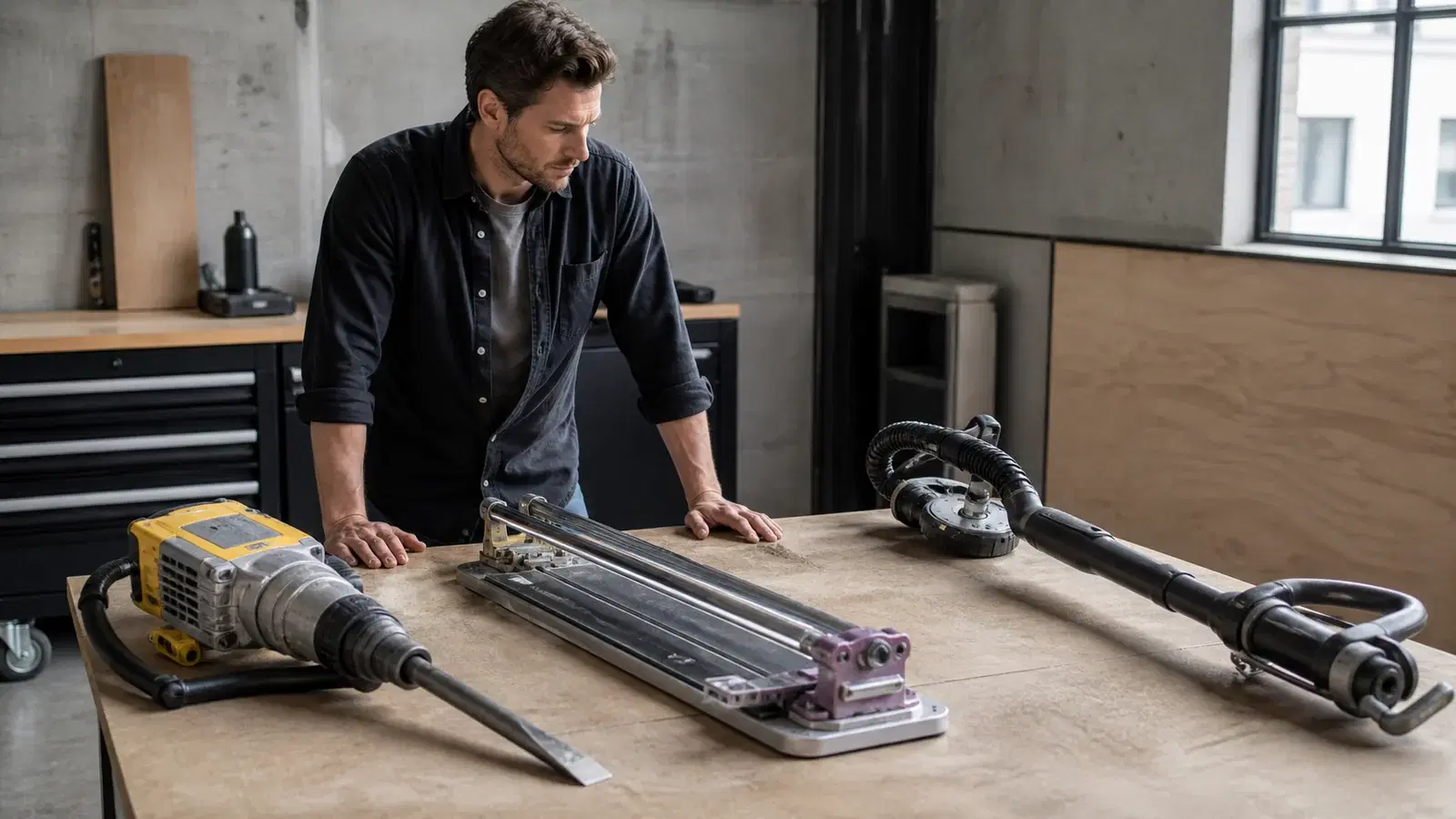
Renting usually wins when a professional tool is needed for one defined job, is expensive, bulky, maintenance-heavy or likely to become obsolete in your shed. Buying makes more sense when you will use the right tool regularly, can store and maintain it, and the realistic total rental cost across those uses exceeds the tool's true ownership cost.
Calculate break-even using total cost
Purchase price omits blades, discs, filters, batteries, repair, transport and storage. A rental headline can omit delivery, cleaning and consumables. Compare the cost of completing the same job safely from pickup to return.
Do not count a refundable deposit as a cost, but recognise the temporary cash commitment. Use a realistic duration with contingency. A resale value is useful only if you genuinely plan to sell and the estimate reflects a plausible buyer and condition.
15 specialist tools that often make sense to rent
Demolition hammer
- Rent when
- For a single slab, step or partition removal.
- Buy when
- You perform demolition regularly and have transport and secure storage.
- What to check
- Bit type, weight, vibration controls, cable and eye, hearing and respiratory PPE.
Core drill and stand
- Rent when
- For a handful of accurately sized holes in masonry or concrete.
- Buy when
- You install building services routinely and understand anchoring and water control.
- What to check
- Core diameter, mounting method, cooling, hidden services and RCD protection.
Wall chaser with dust extractor
- Rent when
- For one electrical or plumbing route project.
- Buy when
- You cut channels often and own suitable dust extraction.
- What to check
- Blade spacing, depth, extractor class and respiratory protection.
Professional tile cutter
- Rent when
- For large-format or hard tiles beyond a basic cutter.
- Buy when
- You tile regularly with similar formats.
- What to check
- Maximum length, diagonal capacity, wheel or blade and transport case.
Floor or parquet sander
- Rent when
- For one room or a single whole-home restoration.
- Buy when
- Floor restoration is ongoing paid work.
- What to check
- Abrasives, edge sander, dust bags and protruding fixings.
Drywall and ceiling sander
- Rent when
- After a one-off large plastering project.
- Buy when
- Finishing work is frequent.
- What to check
- Extractor connection, disc size, extension and abrasives.
Drywall panel lift
- Rent when
- When fitting a ceiling alone or for one project.
- Buy when
- A crew will reuse it across sites.
- What to check
- Lift height, load rating, wheel brakes and doorway clearance.
Concrete mixer
- Rent when
- For a fence, steps or a short paving job.
- Buy when
- You mix frequently and can wash and store the machine.
- What to check
- Usable drum volume, power, stability and cleaning terms.
Plate compactor
- Rent when
- For one patio, path or small base.
- Buy when
- You install paving routinely.
- What to check
- Operating mass, depth, transport wheels and fuel.
Earth auger
- Rent when
- For fence, deck or planting holes in one phase.
- Buy when
- You drill similar ground often.
- What to check
- Diameter, soil conditions, utility survey and operator requirements.
Stump grinder
- Rent when
- For a few accessible stumps on one property.
- Buy when
- Tree care is your professional service.
- What to check
- Access width, stones, guards and exclusion zone.
Wood chipper
- Rent when
- After one major seasonal pruning session.
- Buy when
- A large garden creates regular batches.
- What to check
- Maximum branch diameter, feed system, emergency stop and transport.
Drain cleaner with inspection camera
- Rent when
- To diagnose and clear a particular blockage.
- Buy when
- You maintain many properties and are trained to control the cable.
- What to check
- Pipe diameter, cable length, recording and hygienic cleaning.
Thermal camera
- Rent when
- For one heat-loss, heating or moisture investigation.
- Buy when
- You inspect frequently and understand emissivity and interpretation.
- What to check
- Resolution, range, calibration and file export.
Professional paint sprayer
- Rent when
- For one large wall, façade or fence project.
- Buy when
- You spray often and can clean the system thoroughly.
- What to check
- Paint compatibility, tip, hose, filters and respiratory PPE.
Rent the complete system, not just the motor
Describe the material, dimensions and outcome. A request for a 'drill' could mean a 6 mm hole in brick or a 150 mm core in reinforced concrete. Give the owner the surface, volume of work, power supply and site constraints so the tool is neither underpowered nor dangerously unsuitable.
Agree which accessories are included, consumable and chargeable. A blade, core bit or abrasive set can exceed a day's hire. Count the case, guards, keys, charger, batteries, hoses and manual, then photograph the complete handover.
Rental availability is not proof of competence
If you cannot identify hidden services, control kickback, manage silica dust or move the equipment safely, use a trained operator or a different method. A manual and brief demonstration do not replace professional training.
Inspect the body, cable, plug, guards, accessories and emergency stop. Use the PPE specified by the manufacturer, isolate power before changing accessories, and stop if a fault develops. Do not dismantle a rented tool yourself.
Pickup and return checklist
Checklist
- Material, dimensions and work volume are agreed
- Power and operating range suit the site
- Every accessory and consumable is listed
- Use, cleaning, late fees and normal wear are clear
- Correct PPE and an exclusion zone are available
- Body, cable, guards and operation were checked
- The complete kit was photographed at pickup and return
Rental can increase utilisation, but is not automatically greener
Circular models aim to keep products in use through sharing, repair and reuse. A well-run rental fleet can increase utilisation and reward maintenance, but long individual journeys, misuse and early damage can erode that benefit.
Choose nearby equipment, group tasks into one rental period and return the complete tool clean. Treat sustainability as a result of the whole system, not a guarantee attached to the word 'rental'.
Sources: Council of the European Union, European Commission Joint Research Centre
Worked scenario: planning one weekend job
Suppose the job is sanding thirty square metres of repaired wall. Begin with the surface, coating and depth of irregularities; those facts determine the machine, abrasive and dust extraction. Send dimensions and clear photographs rather than asking for the 'best sander'. Check that the electrical circuit and extension lead are rated for the combined machine and extractor load.
Separate the machine, extractor, hose, adapters, abrasive discs, delivery and deposit on the cost sheet. Abrasives may be sold consumables rather than returnable equipment. A one-day rate is misleading if preparation and cleanup consume another half day, so price the realistic booking window and compare it with the late-return rule. Any numbers used in your calculation should come from the specific listing.
Ask the owner to demonstrate startup, speed control, dust connection and safe accessory changes. Make a small test pass while wearing the specified respiratory, eye and hearing protection. Stop if vibration is abnormal, a cable is damaged or a guard will not lock. Do not improvise repairs to hired equipment: isolate it, preserve the fault and contact the owner.
Reserve time for the cleaning permitted by the manual. Count adapters, keys, backing pads and cases, and coil cables without sharp bends. Photograph the tool operating and the complete kit before closing the case. This evidence reduces disputes, while careful cleaning and honest fault reporting help the next renter receive equipment that has actually been checked.
After the job, update the break-even model with observed data. Include consumables, travel, setup hours and the time the professional machine actually saved. If a similar project returns, you can compare another rental, a used purchase and a contractor using real throughput rather than optimism. One successful weekend does not prove ownership is cheaper, especially if the next task needs different power or accessories. Conversely, several hires in a short period can reveal stable demand, but only after ownership includes maintenance, repair risk, secure storage and a plausible resale value. Keep the calculation as a decision record and change it when the facts change.
Frequently asked questions
When is buying clearly better?
When the correct tool will be used often, break-even arrives within a realistic period, and you can store, maintain and operate it safely.
Will I pay for a worn blade?
Terms vary. Agree in writing whether blades, belts, bits and filters are included and how normal versus excessive wear is measured.
May another person use the rented tool?
Only if the owner and platform terms allow it. The contracting renter remains responsible, so do not pass equipment to an unagreed operator.
How long should I book?
Include preparation, a test pass, the job, cleaning and transport. Add reasonable contingency and compare a multi-day package with the cost of running late.
Sources and methodology
Fact-checked 9 August 2026
- The circular economy explained — Council of the European Union
- Product-as-a-Service: a consumer model for a more circular economy — European Commission Joint Research Centre