

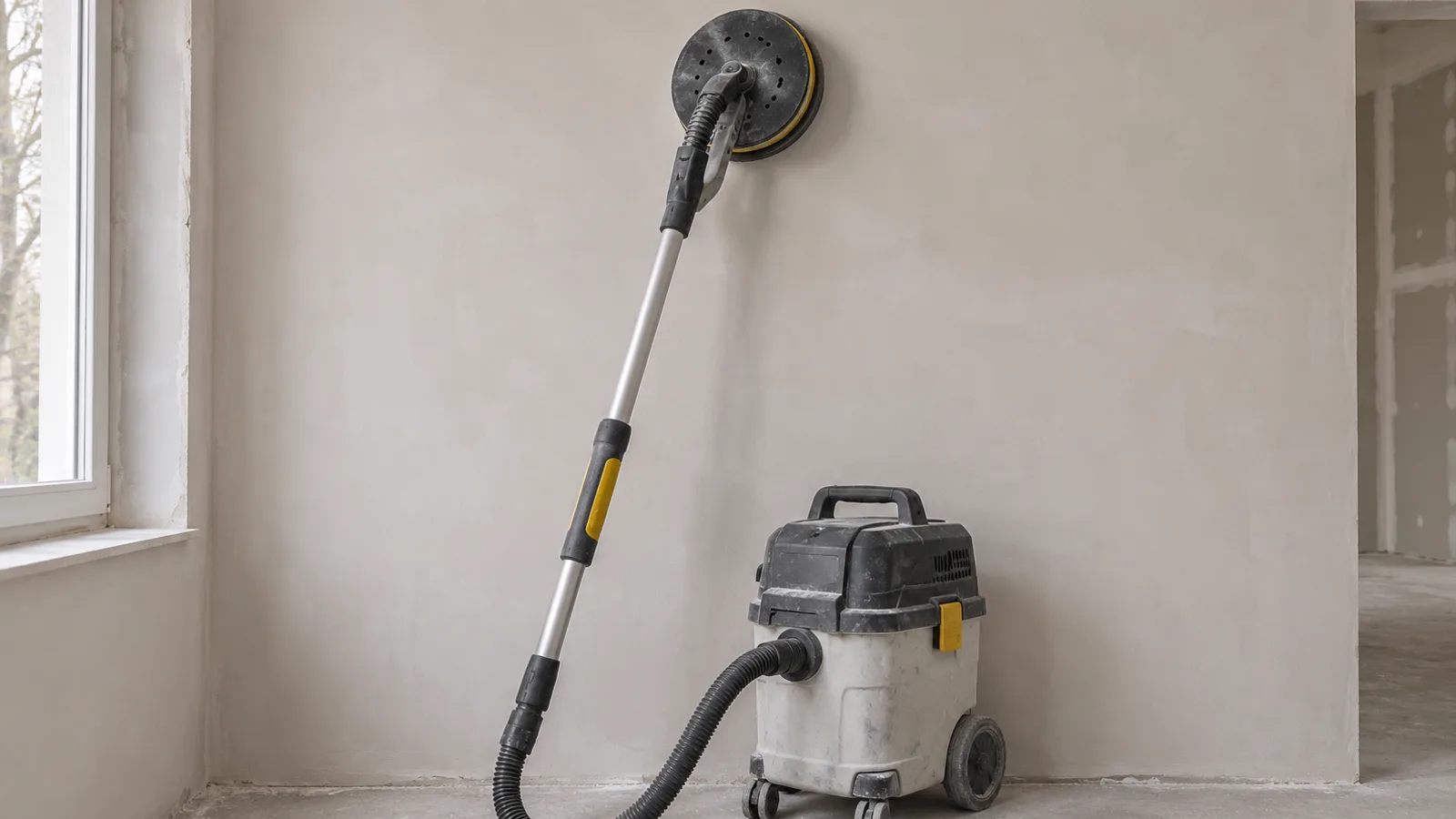
When is it worth renting a drywall sander?
A drywall sander is a long-reach tool for smoothing dried filler on walls and ceilings. On plasterboard, sand only the joint compound so that it blends into the board surface. Do not damage the paper facing or the joint tape. On skim-coated concrete, sand only the skim coat. Bare concrete and other hard substrates need equipment and dust controls chosen for that material.
| Job | What to choose |
|---|---|
| A few joints, patches or internal corners | A sanding block or a tool designed for corners. A round head cannot reach right into an internal corner. |
| Fully skim-coated room walls | A long-reach sander with a flexible head and adjustable speed. A shorter shaft is easier to control in a confined room. |
| Large ceilings or tall walls | A model whose length and balance you can try with the hose attached. If you cannot reach the surface from the floor while standing steadily, use a suitable work platform. The scaffolding rental guide explains how to choose one. |
A telescopic shaft slides out, while a modular shaft changes length when you add or remove the manufacturer's extensions. Shaft length is only one factor in working reach. A longer shaft reaches further but makes the head harder to control. Rotary heads turn the disc around its axis, while eccentric heads also move in an orbit. Mirka states that the random orbital motion leaves fewer deep scratches than rotary sanding. Match the speed and abrasive to the filler and try them on a small patch.
Festool PLANEX and Mirka LEROS compared
| Feature | Festool PLANEX LHS 2 225 EQI | Mirka LEROS 950CV EU |
|---|---|---|
| Length and weight | 1.20 m and 4.0 kg without an extension, 1.65 m and 4.7 kg with one extension (manual). | 1.44 m and 3.5 kg without the optional extension (Mirka catalogue). |
| Stroke and speed | 4 mm eccentric stroke, 5,000–8,500 min⁻¹. | 5 mm orbit, 4,000–8,000 min⁻¹. |
| Head and extraction | LED ring light and adjustable suction against the surface. The manual requires an antistatic 36 or 27 mm hose and recommends 36 mm. | Head pivots up to 180°. Mirka lists a compatible 27/32 mm hose and connector. |
The PLANEX ring light helps reveal ridges. The head draws itself onto the surface, which takes load off your arms. The manual says to start with low suction and increase it until you feel the head being pulled on. Too much suction overloads the tool and spoils the finish. The LEROS weighs less in the configurations shown, and the flexible head helps keep the pad flat as you change angle. The extractor hose also changes how both tools balance, so try the whole setup before ceiling work.
A separate Mirka LEROS listing in Justiniškės, Vilnius, showed €25 per 24 hours with a €300 deposit on 11 November 2026. Collection is from a shop where, according to the description, sanding discs and sponges can be bought. Confirm the model and ask whether a dust extractor can be rented with it.
Which abrasive mesh or sanding paper should you use?
Read the filler technical data sheet first. Knauf's general guidance gives 120 grit as a typical starting point for powdered fillers. Its Fill & Finish Light sheet recommends 180–240 for that product. If the surface stays rough, the Festool manual suggests a finer grit such as P240 or P320. On a test patch, start with the finest abrasive that still removes the ridges. If you need a coarser pass, sand out its scratches with a finer grit. Fill deeper hollows and let those patches dry.
Both tools in the table take 225 mm discs. Check the fastening and whether the backing pad needs an interface. Festool warns against fitting more than one interface pad. Align the holes in perforated paper with the extraction holes in the pad. Mesh lets air pass across its whole face when used with a compatible pad or interface. Replace clogged or damaged discs.
How do you get an even finish and reduce dust exposure?
Set up the room and the dust extractor
Capture dust at the sanding head. For sanding plasterboard joints, the UK's Health and Safety Executive (HSE) specifies an L, M or H class extraction unit. The PLANEX manual recommends Festool's M class CTL/M 36 E AC-LHS or PLANEX extractor, and Mirka pairs the LEROS with its M class DEXOS extractors. Check airflow, hose connections, filter and bag. Fine dust can remain airborne even when you cannot see it. Isolate the work area, ventilate to the outside and keep dust from spreading to other rooms.
Wear eye and hearing protection and a particle respirator. Where dust levels are high, the HSE advises an FFP3 respirator. It must seal closely to the face, and beards or stubble prevent that. Inspect plugs and cables, work in dry conditions and unplug the sander before changing abrasives or taking it apart.
Start with a small test patch
- Let the filler dry fully. The filler instructions give the drying time and conditions. Shine a light across the surface to find trowel marks and hollows.
- Keep the pad flat. The PLANEX manual says to switch the tool on first and only then place it on the surface. Guide it with both hands, use light pressure and make overlapping passes. Keep the head moving while it runs, and put the tool down only once the head has stopped. Take breaks during ceiling work before you tire.
- Inspect with side lighting. Vacuum the surface and check the joints and edges closely. Vacuum the floor too, because dry sweeping raises a lot of dust. Follow the finishing system's instructions before priming.
How much does rental cost and what should you check at collection?
Lithuanian rental rates checked on 11 November 2026 ranged from €10 to €20 a day for the sander alone. Mundis in Kaunas advertised the Bosch GTR 55-225 at €10/day and either the Mirka LEROS 950CV or Festool PLANEX LHS 2 225 EQI Plus at €20/day. PartsGarden in Kaunas listed a FLEX at €17 per 24 hours or €5 per hour. Gotas charged €20/day including VAT for the Festool LHS 225 EQ for 1–5 days and €17/day for 6–25 days. It also rented extractors at €12–14/day and sold 225 mm sanding discs at €2–3 each. Compare quotes for the same duration and equipment.
On the same date, a Festool sander with an extractor on Naudokis.lt in Vilnius cost €37 per 24 hours, with a €100 card hold for the deposit. The extractor bag costs extra. For comparison, a Gotas sander and extractor together would cost €32–34/day. Discs, bags, delivery and platform fees can add to the cost. Budget for the deposit separately, since the hold reduces the funds available on your card.
Checklist
- Ask for the exact sander and extractor models. Check for the hose, fitting, extension, backing pad and any required interface.
- Inspect the pad, head joint, shaft locks, cable and plug. Ask to see the tool running with the extractor attached.
- Agree who supplies discs, filters and bags. Check the return time, cleaning terms and any late charges.
- Measure the longest packed part or case and leave room for the extractor. Secure the equipment in the vehicle.
Start the rental on the day the filler is dry. Allow time for corners, inspection under side lighting, cleanup and return. If your project has separate sanding stages with drying time in between, compare one longer rental with separate collections. The guide to renting or buying tools covers when buying pays off. Browse the power tool catalogue for more sanders.
Related articles
 Tools and constructionRent or buy tools? A simple calculation and 15 examples
 Rent or buy30 things that often make more sense to rent than buy
Sources
Model specifications come from manufacturer documentation. Abrasive and dust control guidance draws on filler data sheets and occupational safety sources. Prices come from public Lithuanian offers checked on 11 November 2026. The illustration is AI-generated.
- PLANEX LHS 2 225 EQI / EQ operating instructions
- LEROS 950CV and LEROS-S 950CV technical data, p. 106
- LEROS 950CV 230 V operating instructions
- LEROS 950CV EU MIW9502022BA and compatible accessories
- Glaistymo ir šlifavimo metodika
- Fill & Finish Light techninių duomenų lapas
- Construction dust: sanding taped and covered plasterboard joints
- Construction dust and respiratory protection
- Respiratory protective equipment: fit testing basics
- Locations of asbestos and taking the right action
- Reduce the Risk of Lead Exposure at Home
- Glaisto šlifuoklių nuomos kainos Kaune
- Festool LHS 225 EQ nuomos kainos ir priedai
- FLEX žirafos nuomos kainos Kaune