

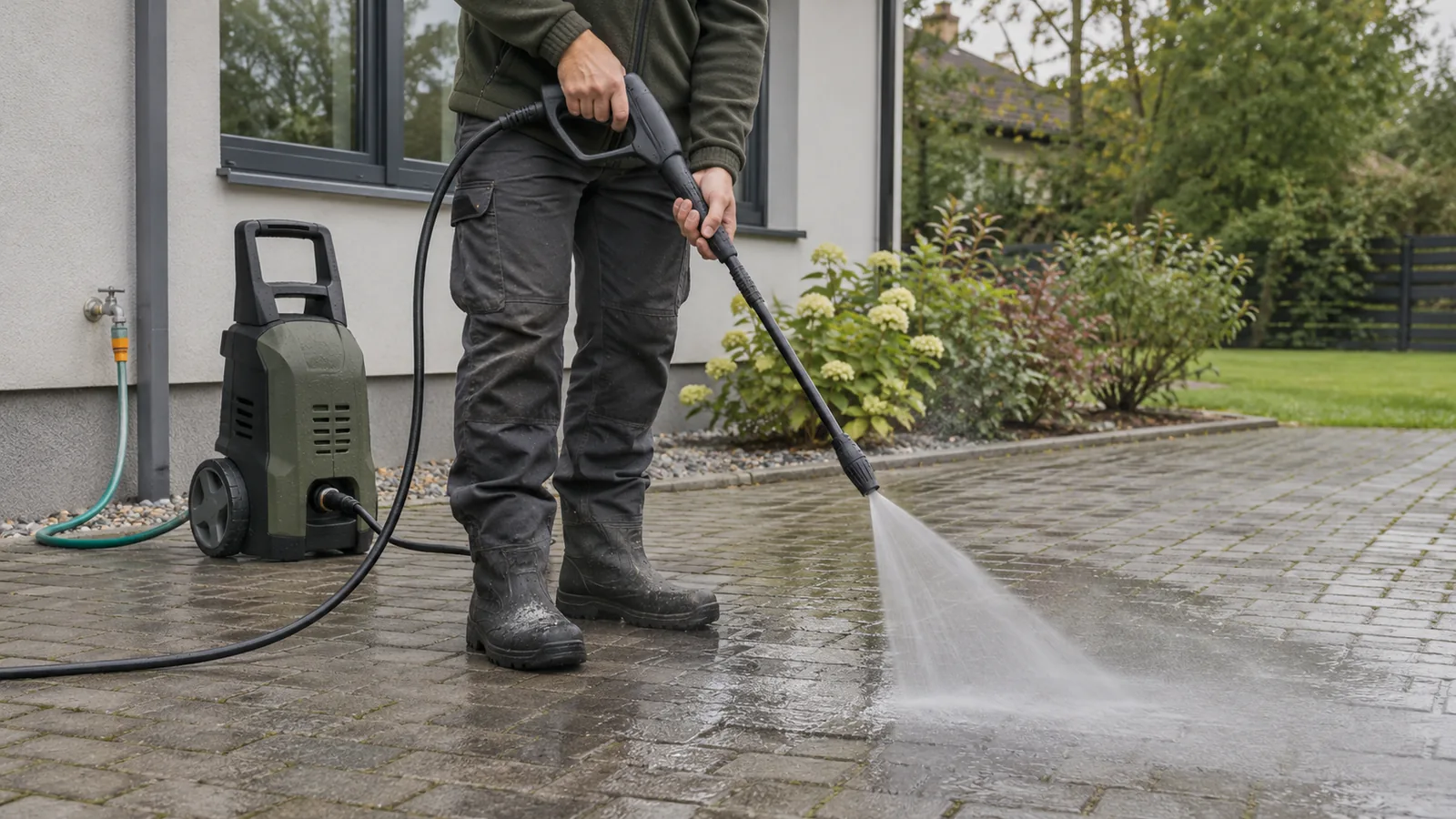
Which pressure washer suits the surface?
Check the material and its condition first. A deck with timber boards and concrete steps may call for a brush on the boards and a pressure washer on the steps.
| Surface | Where to start | What to protect |
|---|---|---|
| Timber decking | Water and a suitable brush, working with the grain. Consider pressure only if the decking instructions allow it. | Soft wood, board ends and flaking finishes. |
| Composite decking (WPC) | Check the board maker’s instructions. If pressure rinsing is permitted, use a fan nozzle within its limits. | The surface texture and protective outer layer. |
| Block paving | Use a fan nozzle on sound, suitable paving. Consider a surface cleaner for a large, level area. | Loose jointing material, loose blocks and crumbling edges. |
| Concrete and stone slabs | Test at low pressure first. Check for cracks, paint and sealants. | Weak concrete, soft stone and protective coatings. |
| Car | Where washing is permitted, use a gentle setting and a wide fan jet. Follow the vehicle manual. | Chipped paint, tyres, seals and sensors. |
| Garden furniture and tools | Start furniture with a soft brush or cloth. Use a fan jet on durable metal tools where suitable. | Woven furniture, fabric, cracked plastic and flaking paint. |
Pressure, water flow and power
- Pressure (bar) helps lift attached dirt. Compare models by working pressure; maximum permitted pressure is a different figure. The spray pattern and distance also affect how hard the jet hits.
- Flow (l/h) is the volume the machine delivers per hour. More flow helps carry loosened dirt away on larger jobs. Check the minimum inlet flow separately.
- Rated input (kW) tells you the load on the electrical supply. Cleaning also depends on the pressure, flow, nozzle and material.
- Area rating (m²/h) is a manufacturer benchmark. Dirt, joints, prep, drainage and the setting you can use all affect how long a job takes.
Kärcher K3, K5, K7 or a professional washer?
Compare the full model and order number. Kärcher’s K series covers household jobs. For longer or more demanding work, compare a professional model’s working pressure, inlet requirements and accessory system.
| Model | Pressure and flow | Input and hose |
|---|---|---|
| K 3 Power Control Car & Home | Up to 120 bar and 380 l/h | 1.6 kW · 7 m |
| K 5 Power Control Flex | Up to 145 bar and 500 l/h | 2.1 kW · 10 m |
| K 7 Premium Smart Control Flex | Up to 180 bar and 600 l/h | 3.0 kW · 10 m |
| HD 6/15 M | 150 bar working, 225 bar max. · 560 l/h | 3.1 kW · 10 m |
The hose lengths run from the machine to the spray gun. These are manufacturer configurations. A rented washer may have a different hose or accessories. Use the surface and equipment instructions to choose a working setting.
- A few garden items or a short path. Where the surface allows pressure washing, consider a compact K3-class washer with an adjustable fan nozzle. The Kärcher K3 listing in Vilnius showed €10 per day and collection in Paneriai. Ask the owner for the model label and the supplied hose and nozzles.
- A larger area of sound paving. The K5 example delivers more water and comes with a longer hose than the K3 example. Confirm whether you can rent a compatible surface cleaner with it.
- A large, heavily soiled area. Consider a K7-class or professional washer. Check the water supply, electrical circuit and loading weight first. Oil stains or crumbling surfaces may need a different cleaning method.
Which nozzles and detergent should you take?
- Adjustable fan nozzle. Spreads the jet. Start with it on a test patch, around edges and for rinsing at a suitable setting.
- Surface cleaner. Encloses rotating jets under a hood. It helps clean level paving evenly and reduces splash. Check the fitting, permissible pressure and exact washer compatibility.
- Rotary or turbo nozzle. Spins a concentrated jet. Use it for local dirt on a resistant surface where the instructions allow it. Keep it away from joints, tyres, wood and paint.
- Foam nozzle or detergent feed. Check how the washer applies detergent. A K 3 Power Control with the Vario Power lance draws cleaner on MIX. The K5 in the table has a Plug ’n’ Clean system.
Choose a cleaner for the material, type of dirt and washer. If the cleaner is intended for separate application, keep it out of the washer’s tank. Follow the label for dilution, contact time and rinsing. Keep the product from drying on the surface. Kärcher’s safety instructions allow detergent only on waterproof surfaces that drain to a wastewater sewer. Detergent must not reach soil or watercourses, so wash without it where the runoff will drain onto a lawn or bare ground. Use only cleaners the washer’s manufacturer supplies or recommends.
How to wash decking, paving and a car
Clear leaves and grit and check where water will run. On an inconspicuous area, use the lowest suitable setting and start with a wide jet from farther back. Observe the manufacturer’s minimum distance. Keep the nozzle moving and stop if the texture changes, a finish lifts or joints start to wash out.
Wood and composite decking
Brush timber with the grain. If the manufacturer allows pressure washing, start on the gentlest setting it permits. A strong jet can raise fibres or strip the finish. Rules vary by composite board. TimberTech’s care guide permits pressure rinsing only with a fan tip. TimberTech’s pressure guidance recommends a washer rated at no more than 1,500 psi (about 103 bar). All four models in the table exceed this rating (even the K3 reaches 120 bar, about 1,740 psi), so by this guidance none of them suits TimberTech boards. Follow the instructions for your own decking.
Paving, concrete and stone
Work with the slope and direct the jet across the block faces. Spraying into the joints can flush out sand and loosen blocks. If joint material washes out, refill it with the material and under the conditions specified for your paving system. Use a gentler method for crumbling concrete, soft stone and surfaces with unidentified coatings.
Car bodywork and tyres
Municipal cleanliness rules decide where you may wash a car. Lithuania’s Environmental Protection Department notes that washing is usually not allowed on streets and verges, in apartment-block yards and shared areas, in car parks, near water bodies, or on lawns and other unsealed surfaces. The same list includes anywhere chemical products are used and the wastewater is not collected. At your own house, make sure the runoff does not contaminate the ground. If you have no suitable spot, use a car wash.
Rinse loose dirt with a wide fan jet. Keep strong spray away from chipped paint, seals and sensors. The K 3 Power Control manual gives a minimum of 30 cm for painted surfaces. Kärcher’s car-washing guide specifies 30 cm for tyres. Follow the stricter requirements in your washer and vehicle manuals and start farther back.
How much water and power does a pressure washer need?
Check the washer’s inlet requirements before collection. The K 3 Power Control manual calls for at least 8 l/min of incoming water. Time a 10-litre bucket from the hose you will use: if it fills in 75 seconds or less, the supply is enough (75 seconds equals 8 l/min). Check the required inlet pressure and temperature separately. The garden hose is not included with the washer: the manual specifies a fabric-reinforced hose at least 1/2 inch (13 mm) in diameter and at least 7.5 m long. Ask the owner whether a hose and fittings come with the rental. The safety instructions state that, by law, the washer may be connected to the drinking-water supply only through a type BA backflow preventer complying with EN 12729. Draw water from a tank only if your washer supports it and you have the specified hose and fittings.
Checklist
- Measure the three runs separately: tap to washer, washer to the farthest work area, and washer to socket.
- Check voltage, phases, circuit protection and the residual current device (RCD) requirement in the manual. The K3 safety instructions specify an RCD rated at no more than 30 mA. A three-phase machine needs a matching supply.
- If the manual permits an extension lead, use an outdoor-rated cable with an adequate cross-section. The K3 safety instructions specify 1.5 mm² up to 10 m and 2.5 mm² for 10–30 m. Fully unwind reels and keep electrical connections dry and off the ground.
- Wear eye protection and slip-resistant footwear. Keep the jet away from people, animals, electrical connections and the washer itself.
- Turn the water on and purge air as instructed. Switch off and release residual pressure according to the manual before disconnecting the high-pressure hose.
What does pressure washer rental cost in Lithuania?
In the offers checked on 11 November 2026, a household washer was advertised at €10 per day and a delivered set at €49 for 24 hours. Compare the total and what is included for your dates.
| Offer | Price | What to check |
|---|---|---|
| Kärcher K3, Naudokis.lt | €10/day | Free collection in Paneriai, Vilnius. €40 card hold. |
| Kärcher 220V, Statrenta | €20/day excluding VAT | The listing does not specify the exact model. Check accessories and the price including VAT. |
| Pressure washing set, NoriuPats | €49/24 hours | Advertises free delivery and collection in Vilnius and Vilnius District, a 20 m water hose, nozzles and a surface cleaner. |
Allow for paid accessories, detergent, delivery or travel and any applicable fees. If a deposit applies, allow enough card balance for the hold. Select dates in the Naudokis.lt listing and check the total in the app before sending a request. The reservation is confirmed once the owner accepts and payment goes through.
How long should you rent for?
A day may be enough for a small job you have prepared in advance. Allow time for collection, a test patch, moving between areas, cleaning the attachments and returning the washer. If joints need refilling, allow for the surface to dry. Confirm collection and return times. Before transport, empty the detergent tank and secure the washer so it cannot slide or tip over. Get help to load a heavy unit. Kärcher says not to operate the washer below 0 °C. If you carry it in freezing weather, drain the washer and accessories fully as the manual describes, because frozen water left inside can damage it. Store it only somewhere frost-free.
When is a professional cleaning service a better fit?
Do not spray surfaces that may contain asbestos, such as old asbestos-cement roof or fence sheets. Kärcher’s safety instructions warn against it. For a crumbling surface, flaking finish or unknown sealant, ask a professional to identify the material and test a patch. Consider a service for deep oil stains, construction residue or work where you must collect contaminated water. It may call for surface-specific chemistry, specialist equipment or hot water. For a car without a suitable wash area, a designated self-service wash has wastewater collection in place.
For an occasional path or driveway clean, rental lets you choose a washer and attachment for that job. For indoor work, see the cleaning equipment catalogue. If you are cleaning upholstery, use the sofa cleaning guide.
Related articles
 Rent or buy30 things that often make more sense to rent than buy
 Tools and constructionRent or buy tools? A simple calculation and 15 examples
 Home and cleaningWindow-cleaning robot rental: when it works and what to check
Sources
We checked specific model numbers against manufacturer data and cleaning methods against equipment and surface instructions. Advertised prices and rental terms were checked on 11 November 2026. The cover image is illustrative.
- K 3 Power Control Car & Home (1.676-105.0)
- K 5 Power Control Flex (1.324-700.0)
- K 7 Premium Smart Control Flex (1.317-360.0)
- HD 6/15 M (1.150-930.0)
- K 3 Power Control
- K 3 Power Control (Safety Instructions)
- T 5 T-Racer (2.644-084.0)
- How to clean pavers
- Holzterrasse reinigen
- Care & Cleaning Guide
- Decking FAQs: Can I powerwash my TimberTech deck?
- Cleaning garden furniture
- Automobilio plovimas namuose
- Musso savininko vadovas
- Automobilių plovimo reikalavimai
- Aukšto slėgio plovykla KARCHER K3, Vilnius
- Valymo ir vandens siurbimo įrangos nuoma
- Aukšto slėgio valymo rinkinys